✕

10 Food Bucket Buying Tips for Global Buyers

Buying a food bucket globally is not a simple price comparison. It is a practical test of safety, durability, logistics, and supplier credibility. A buyer may inspect a glossy catalog, then discover weak lids, inconsistent wall thickness, or unclear food-contact documentation. The details matter.

The Food and Agriculture Organization reports that 13.2% of food is lost between harvest and retail globally. The United Nations Environment Programme also estimated 1.05 billion tonnes of food waste in 2022. A suitable food bucket cannot solve waste alone, but its seal, stackability, and reusability can support better storage practices. Buyers should examine material grades, temperature limits, odor transfer, tamper evidence, handle strength, and cleaning performance. Supplier audits and laboratory certificates deserve more attention than attractive product photos.

Food safety expert Frank Yiannas has said, “Food safety is a shared responsibility.” That principle applies across manufacturers, importers, distributors, and end users. This guide presents ten food bucket buying tips for global buyers, including sampling, compliance review, freight planning, and total-cost analysis. A low factory price can become expensive after leakage, rejected shipments, or damaged goods. We should also admit one limitation: no checklist replaces a real-use trial. Test filled buckets, stacked pallets, cold storage, rough handling, and repeated opening. Small mistakes become visible quickly. Sources include FAO’s food-loss reporting and UNEP’s Food Waste Index Report 2024.

10 Food Bucket Buying Tips for Global Buyers

Define Your Food Storage Needs and Buying Goals

Define Your Food Storage Needs and Buying Goals

Before buying food buckets, decide what they must support. A household preparing for two weeks needs different quantities than a remote worksite planning for six months. Write down the number of people, daily calories, dietary restrictions, and cooking equipment available. Be precise. Include infants, older adults, allergies, and cultural food preferences. A bucket filled with foods nobody can eat is expensive storage, not useful security.

Climate also changes the buying goal. Heat, humidity, freezing temperatures, and pests can damage food or packaging. Choose a dry, shaded storage area with stable temperatures. Check seals, production dates, ingredient lists, and preparation instructions before purchase. For international buyers, review import rules, labeling requirements, and allergen declarations in the destination market. Never assume a product accepted in one country is accepted everywhere.

A practical goal includes rotation. Buy foods your household already eats, then replace older items during normal meals. I have seen buyers focus on long shelf life and ignore water, fuel, or cooking time. That plan looks strong on paper but fails during preparation. Start with a small trial bucket. Test taste, portion sizes, rehydration time, and storage space. Some foods may seem affordable until waste appears. Keep a written inventory, but accept that your first estimate may be wrong. Review it after one month and adjust quantities, packaging, and meal plans.

Evaluate Bucket Materials, Sizes, Designs, and Features

10 Food Bucket Buying Tips for Global Buyers

Bucket material determines more than durability. Food-grade HDPE suits many dry ingredients because it resists impact and moisture. PP can offer better heat resistance, but its performance depends on the formulation. Ask for food-contact declarations, migration-test results, and traceability documents. Recycled content requires extra scrutiny in regulated markets. Rules differ by destination.

Size should match handling, shelf life, and opening frequency. FAO’s State of Food and Agriculture 2019 reported that about 14% of global food is lost between harvest and retail. Poor portion control can increase this waste. Choose smaller buckets for ingredients used slowly. Large buckets work better for high-volume kitchens and factories. Leave practical headspace, not excessive empty space.

Design details often decide operational value. Look for smooth interiors, rounded corners, secure lids, and handles that remain comfortable with wet gloves. Stackable shapes reduce warehouse volume. A gasket can improve closure performance, but it may complicate cleaning. Not every bucket needs UV protection or a strong oxygen barrier. Match the feature to the product. UNEP’s Food Waste Index Report 2024 estimated 1.05 billion tonnes of food waste in 2022, so resealing and portion-friendly formats deserve attention. In supplier evaluations, I would test filled buckets, not empty samples. That exposes awkward lifting, lid distortion, and unstable stacking. A perfect design does not exist. Some “premium” features may simply add cost.

10 Food Bucket Buying Tips for Global Buyers

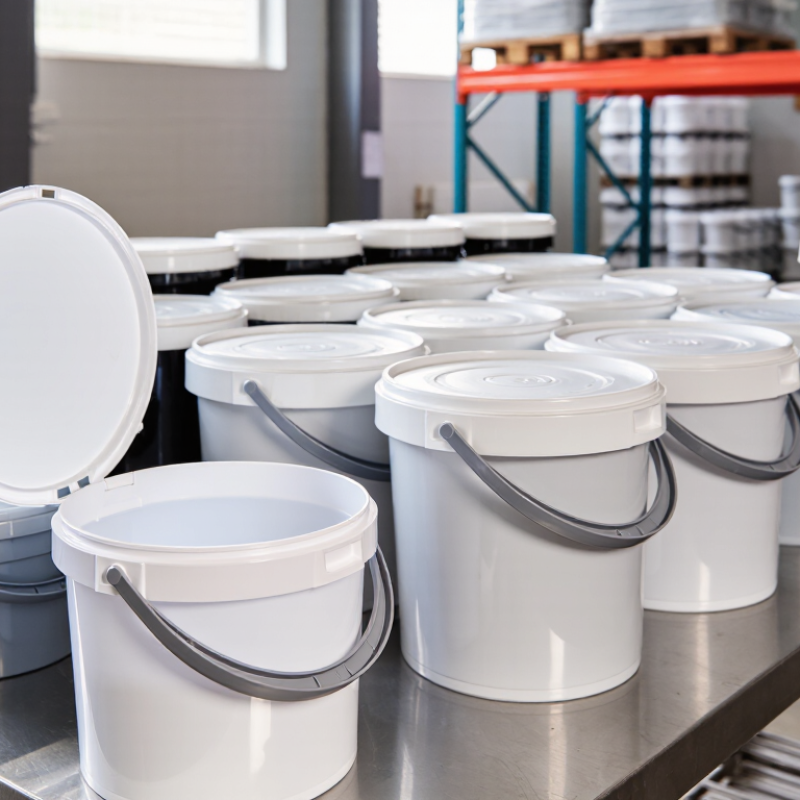
Evaluate bucket materials, sizes, designs, and features before selecting a food-packaging solution.

Common nominal food-bucket capacities range from approximately 1 to 25 liters. Smaller buckets suit spices, sauces, and samples, while 10–25 liter formats are commonly used for bulk ingredients, foodservice storage, and industrial handling. Confirm the material grade, lid seal, handle strength, stacking design, tamper evidence, and compliance requirements for the destination market.

Material

Food-contact polypropylene and high-density polyethylene are widely used because of their chemical resistance, durability, and low moisture absorption.

Design

Check tapered geometry, stackability, lid fit, wall thickness, and whether the bucket is suitable for manual or automated filling.

Features

Useful options include tamper-evident closures, carrying handles, batch marking areas, measuring guides, and recyclable construction.

Reference values show common nominal bucket capacities; actual sizes and specifications vary by market and application.

Check Food Safety Standards and Regulatory Compliance

For global buyers, a food bucket is not compliant merely because it looks clean. Its material must suit the intended food, temperature, storage time, and filling process. Request a food-contact declaration, test reports, and batch traceability before approving samples. Check whether the plastic, colorants, lids, seals, and printing inks meet the destination market’s rules. A container for acidic sauce may require different evidence from one used for dry grains. Details matter. Ask for migration testing under realistic conditions, not only a generic certificate. Hot filling, freezing, sunlight, and fatty foods can change material performance.

Review the importer’s labeling duties, recycling marks, net-weight rules, and language requirements early. Regulations can differ between countries, and enforcement may vary by product category. A supplier’s document may be valid in one market but incomplete in another. Use official government guidance or a qualified local compliance professional to verify requirements. Keep purchase specifications, laboratory results, production dates, and inspection photographs in one controlled file. This record helps trace a problem quickly if a lid cracks or an odor appears.

I have seen buyers focus on unit price and overlook secondary packaging or warehouse hygiene. That choice can weaken an otherwise strong compliance plan. Do not assume a familiar certificate proves everything. It may not. Recheck requirements when the food formula, bucket size, or destination changes.

Compare Suppliers, Prices, Minimum Orders, and Customization

10 Food Bucket Buying Tips for Global Buyers

Tip 1: Compare at least three suppliers before requesting a quotation. Check factory experience, food-contact certifications, export records, and production capacity. Tip 2: Ask for a complete price breakdown, including bucket, lid, handle, printing, tooling, packing, and freight. A low unit price can hide expensive setup fees. Tip 3: Confirm whether prices are based on one shipment or annual volume. Tip 4: Request samples from the same production line. Plastic thickness, lid fit, and stacking strength can vary noticeably.

Tip 5: Review the minimum order quantity carefully. A smaller order may cost more per unit but reduce storage pressure. Tip 6: Ask about mixed colors or sizes within one order. This can support market testing, although some factories refuse it. Tip 7: Confirm lead times for samples, tooling, mass production, and shipping. Add time for inspection. Tip 8: Discuss customization in measurable terms, such as capacity, wall thickness, color code, lid design, label position, and print durability. Vague artwork often creates delays.

Tip 9: Check packaging details with photos. Buckets should arrive clean, nested properly, and protected from deformation. Tip 10: Put quality standards in writing before payment. Include tolerance limits, odor requirements, drop tests, and inspection procedures. I once underestimated carton volume, which raised freight costs later. That mistake was avoidable. Keep records of approvals, revisions, and payment terms. A reliable supplier should answer clearly, provide consistent documents, and explain limitations instead of promising everything.

10 Food Bucket Buying Tips for Global Buyers - Compare Suppliers, Prices, Minimum Orders, and Customization

No. Buying Tip Suitable Supplier Type Indicative Unit Price* Typical MOQ* Customization Options Typical Lead Time* What Global Buyers Should Verify
1 Confirm food-contact compliance before comparing prices Established food-packaging manufacturer with documented quality systems US$0.35–US$2.50 per bucket, depending on size and design 1,000–10,000 pieces Color Lid style Handle 20–45 days Request food-contact declarations, migration-test results, material specifications, and batch traceability documents applicable to the destination market.
2 Select the correct plastic grade for the food application Injection-molding supplier experienced with food containers US$0.45–US$3.00 per bucket for common reusable formats 2,000–10,000 pieces PP HDPE Recycled-content option 25–50 days Match the material to temperature, oil, acidity, freezing, stacking, and reuse requirements. Confirm whether recycled content is permitted for the intended food use.
3 Compare total landed cost instead of factory price alone Export-capable supplier or sourcing partner with logistics support Add freight, insurance, duties, inland delivery, and inspection costs to the quoted unit price Usually based on one or more export cartons or pallets Carton marks Pallet pattern Export packing 30–60 days including shipping Compare quotations using the same Incoterm, destination port, currency, packaging standard, payment terms, and delivery quantity.
4 Check capacity and dimensional tolerance carefully Standard-product manufacturer with a broad tooling library US$0.30–US$1.80 for common 1–5 liter formats 500–5,000 pieces for stock designs 1–20 L sizes Shape Graduation marks 10–30 days for stock items Request a technical drawing showing brimful capacity, usable fill level, wall thickness, mouth diameter, lid fit, and allowable dimensional tolerances.
5 Evaluate lid sealing and leakage resistance Packaging supplier offering tamper-evident and gasketed closures US$0.60–US$4.00 for buckets with enhanced closure systems 1,000–8,000 pieces Tamper band Gasket Snap or screw lid 25–50 days Ask for inverted-leak, opening-force, stacking, and drop-test results using the actual product weight and filling conditions.
6 Use sampling and pre-shipment inspection to control quality Supplier willing to support third-party or buyer-appointed inspection Inspection commonly charged separately; budget about US$200–US$500 per inspection day Inspection normally begins from 1,000 pieces Golden sample AQL plan Inspection report 1–3 inspection days Define critical, major, and minor defects; inspect dimensions, lid fit, odor, appearance, print quality, cleanliness, and carton quantity.
7 Clarify printing, labeling, and artwork requirements In-mold labeling, offset-printing, or sleeve-label packaging supplier Add approximately US$0.03–US$0.30 per unit for standard decoration 3,000–20,000 pieces for printed orders 1–6 color print Sleeve Embossing 30–60 days Approve a physical color proof, confirm print durability, provide vector artwork, and verify required language, recycling marks, lot codes, and barcode standards.
8 Compare standard tooling with fully custom tooling Mold maker or manufacturer with in-house engineering capability Existing mold: usually no tooling charge; new mold: often US$3,000–US$30,000+ 5,000–50,000 pieces for a custom design Custom geometry Logo relief Handle design 45–90 days for new tooling Confirm mold ownership, maintenance responsibility, revision rights, trial-shot approval, expected mold life, and whether the tooling fee is refundable or amortized.
9 Check stacking, warehouse, and transport efficiency Supplier able to provide palletization and container-loading data Packaging efficiency can materially affect freight cost, even when unit price is unchanged Often quoted by carton, pallet, or container quantity Nestable design Carton size Pallet layout 15–45 days after approval Request nested height, cartons per pallet, pallets per container, gross weight, cubic volume, and load stability information before placing the order.
10 Negotiate a clear specification and repeat-order process Supplier with documented production controls and stable raw-material sourcing Use a written target price with agreed adjustment rules for resin, decoration, and freight changes Reorder MOQ may be lower after the first production run Master sample Quality agreement Forecast orders 15–40 days for repeat orders Record material grade, color tolerance, dimensions, weight, artwork version, packaging, inspection terms, warranty, claims process, and delivery schedule.
*Indicative ranges are general market benchmarks for food-grade plastic buckets and may vary by capacity, material, closure design, decoration, order volume, tooling, destination, certification requirements, and shipping terms. Obtain a current written quotation and compliance documentation before purchase.

Inspect Quality and Plan Shipping, Storage, and Long-Term Use

10 Food Bucket Buying Tips for Global Buyers

Inspect every bucket before shipment. Look for uniform walls, clean seams, secure lids, and intact gaskets. A clean-looking bucket can still hide weak plastic around the handle. Ask for food-contact declarations, batch records, and independent migration-test results. Confirm whether the container blocks moisture, oxygen, and light. These details matter for grains, powders, and dried foods.

Shipping conditions deserve equal attention. The FAO reported that 14% of food was lost between harvest and wholesale in 2019. Poor packaging and storage contribute to this gap. Use pallets that prevent crushing and allow airflow. Record temperature and humidity during trial shipments. Check container loading plans for condensation risks. A small desiccant pack may help, but it cannot fix a leaking lid. Inspect buckets again after sea transit.

Storage planning should include clean floors, pest control, ventilation, and safe stacking limits. Keep older stock visible and use realistic rotation dates. The UNEP Food Waste Index 2024 estimated 1.05 billion tonnes of food waste in 2022. Long-term packaging choices can reduce avoidable loss, but only when users follow them correctly. Test repeated opening, washing, and lid replacement before large orders. One assumption deserves challenge: “reusable” does not always mean durable. UV exposure, rough handling, and chemical cleaners can shorten service life. Document these weaknesses honestly. That makes the buying decision more reliable.

✕
Get Free Instant Quote

    Questions? We can help.
    Contact a Packaging Specialist for product & pricing information.
    ❄
    ❄
    ❄
    ❄
    ❄
    ❄
    ❄
    ❄
    ❄
    ❄
    ❄
    ❄
    ❄
    ❄
    ❄
    ❄
    ❄
    ❄
    ❄
    ❄
    ❄
    ❄
    ❄
    ❄
    ❄
    ❄
    ❄
    ❄
    ❄
    ❄
    ❄
    ❄
    ❄
    ❄
    ❄
    ❄
    ❄
    ❄
    ❄
    ❄
    ❄
    ❄
    ❄
    ❄
    ❄
    ❄
    ❄
    ❄
    ❄
    ❄