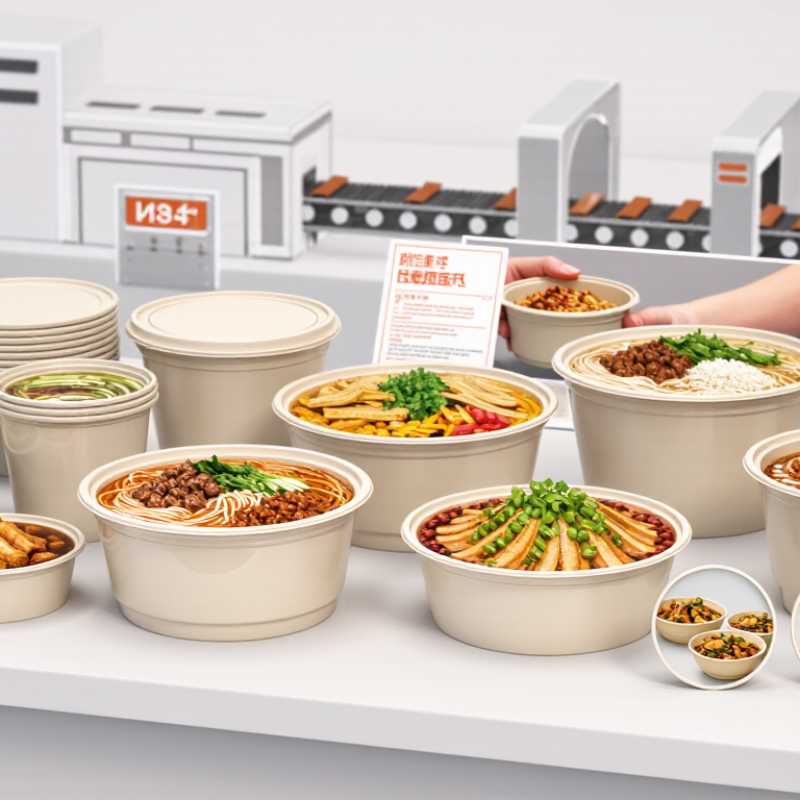
A curated selection of packaging products that fly off our shelves. Our customers love these bestsellers for their practicality and visual appeal, ensuring your products stand out and attract more buyers.
Choosing the China Best Paper Bowl Supplier for Global Buyers? The answer is not automatically the cheapest factory. It depends on materials, production control, documentation, and consistent communication. A dependable supplier should explain bowl capacity, paperboard grade, coating type, rim strength, and packing details clearly. Buyers should also review food-contact documentation, factory quality procedures, and independent test reports where appropriate.
Packaging industry expert Anne Marie Mohan has described packaging as “a product’s silent salesperson.” That idea fits every Paper Bowl placed on a restaurant counter. A clean rim, firm base, and stable print can influence customer confidence before the first bite. Experienced Chinese manufacturers may offer useful advantages, including flexible customization, efficient equipment, and competitive production capacity. However, factory photos are not enough. Samples must survive stacking, hot food, oily sauces, transport vibration, and real filling conditions. Small failures matter.
Ask for evidence, not promises.
A serious supplier should provide traceable samples, production specifications, and a realistic lead-time plan. Communication quality also reveals operational maturity. Slow answers may become expensive delays later. Still, no supplier is perfect. Even a strong factory can face paper shortages, equipment maintenance, or color variation. Buyers should acknowledge these risks and create inspection checkpoints before mass production. Comparing suppliers on total reliability, rather than unit price alone, creates a more practical sourcing decision. The best Paper Bowl partner is the one that can prove performance repeatedly, not merely describe it attractively.
Choosing the best paper bowl supplier in China requires more than comparing prices. Global buyers need stable quality, clear communication, and evidence behind every claim. An experienced supplier should explain its pulp sources, coating materials, forming process, and production limits in simple terms. Factory experience matters. It shows in cleaner edges, even rims, and bowls that remain firm with hot soup.
Ask for food-contact test reports, material specifications, and recent quality records. These documents should match the actual bowl, not a similar sample. A reliable supplier can provide samples from regular production, not only carefully selected pieces. Check thickness, leak resistance, stacking strength, and printing accuracy. Small details matter. A two-millimeter rim variation can affect sealing equipment and shipping stability.
Production control also separates a capable supplier from a risky one. Look for incoming-material checks, in-line inspections, and recorded final sampling. Clear lead times and realistic capacity estimates are equally important. A supplier that admits its limits may be safer than one promising everything. No factory is flawless. I have seen attractive samples fail after long storage or humid transport. That is why buyers should test cartons in real warehouse conditions and review corrective actions before placing large orders.
Choosing the best paper bowl supplier in China requires more than comparing prices. Global buyers should examine manufacturing capability, food-contact compliance, and quality consistency. Ask for the factory’s legal registration, production address, audit records, and current testing documents. Certificates should match your destination market, not merely look impressive in a sales file.
Request samples from different production batches. Check rim strength, leak resistance, coating uniformity, and print accuracy. Fill each bowl with hot soup for several minutes. A bowl that survives a short office test may still fail during transport or extended use. Review the supplier’s raw material sources, inspection points, mold capacity, and batch-traceability process. Confirm carton dimensions, loading quantities, minimum order volumes, and realistic lead times in writing. Cheap quotes often exclude tooling, testing, or replacement costs.
Tips: Ask for a small trial order first. Compare samples under identical conditions. Visit the facility, or arrange an independent audit. Check how complaints are recorded and corrected. A supplier that answers clearly is useful; one that promises everything may create risk. Do not rely on polished photos alone. I once underestimated packaging strength, and damaged cartons erased the expected savings. Build a written quality standard with measurable limits, including bowl weight, wall thickness, leakage time, and acceptable defect rates. Some details will need revision after the first shipment. That is normal, but ignoring them is not.
Choosing a China paper bowl supplier requires close attention to materials, structure, and customization. Most bowls use food-grade paperboard with a moisture-resistant lining. Water-based coatings can suit many applications. Plastic linings may offer stronger leak resistance, but buyers should verify local requirements.
I have inspected bowls for hot soup, oily noodles, and chilled desserts. Small details matter. A firm rim improves handling. A rolled edge can reduce spills and protect fingers. Bowl depth affects stacking, filling speed, and delivery stability. A thicker board is not always better. It can increase cost and waste without improving performance.
Customization goes beyond printed color. Buyers can request different capacities, rim shapes, base diameters, and pack quantities. Printing should remain clear after refrigeration or contact with steam. I recommend testing samples with the actual food and holding time. Laboratory reports are useful, but real use can reveal weak seams or soft bases. Ask for material specifications, production samples, and food-contact documents for the destination market. One overlooked point is warehouse humidity. Paper bowls may deform before use. This deserves a practical storage test.
China Best Paper Bowl Supplier for Global Buyers?
Quality begins with food-contact safety, not appearance. A dependable paper bowl supplier should provide material specifications, coating details, and current laboratory reports. These records should cover overall migration, restricted substances, odor, and microbial control where applicable. Ask whether the paper, ink, and adhesive are suitable for the intended food and temperature range. Hot soup can expose weaknesses that a visual inspection misses.
Export compliance also requires traceability. Each production batch should connect to raw material records, inspection results, and packing information. Factory audits can reveal storage problems, poor hygiene, or inconsistent process controls. Request samples from regular production, not only polished showroom samples. Check rim strength, leakage resistance, stacking stability, and performance after heating. Small details matter.
Requirements differ by destination, product use, and packaging design. A test report alone does not prove complete compliance. Importers should confirm applicable rules with qualified local professionals. Suppliers should explain their corrective-action process when results fail. No system is perfect. A missed inspection or outdated certificate can create avoidable delays. I have found that clear documentation, honest communication, and repeat testing build more trust than impressive claims. Reliability is demonstrated shipment by shipment.
Quality Standards, Food Safety, and Export Compliance Requirements
The chart highlights major food-safety laws and standards commonly referenced when evaluating paper bowl suppliers for international markets. The years indicate the original adoption or current revision year of each reference; they are not supplier rankings or legal approval dates.
References: EU Regulation (EC) No 1935/2004, EU Regulation (EC) No 2023/2006, ISO 22000:2018, the U.S. Food Safety Modernization Act of 2011, and Codex CXC 1-1969, 2020 revision.
China Best Paper Bowl Supplier for Global Buyers?
A Step-by-Step Guide to Sourcing Paper Bowls from China
Define the bowl before contacting suppliers. Record the rim diameter, height, capacity, and intended food temperature. Decide whether you need single-wall or double-wall construction. A 750 ml soup bowl needs different stiffness from a small dessert bowl. Write down the paper weight, coating type, print colors, lid fit, and monthly volume. Small details prevent vague quotations.
Request samples from several qualified manufacturers. Check the bowl on a kitchen scale. Fill it with hot soup for 30 minutes. Look for softening, leaks, odor, and rim deformation. Ask for material specifications and food-contact test reports matching your destination market. My first sourcing mistake was trusting a smooth sample without testing the lid. The fit failed during transport. That was expensive.
Compare quotations line by line. Separate bowl prices, printing plates, lids, cartons, inspection, and delivery terms. Confirm the minimum order quantity and production lead time in writing. Visit the factory, or arrange a live video review of its forming, printing, and packing areas. Check whether cartons are dry, sealed, and clearly labeled. Approve a pre-production sample before mass manufacturing. Use independent inspection when the order value justifies it. Keep a signed specification sheet, because memory changes quickly.
| Step | Data Dimension | Typical Commercial Benchmark | Key Documents or Verification Points | Recommended Buyer Action |
|---|---|---|---|---|
| 1 | Product application | Takeaway food Soup Salad Dessert Microwave use Define whether the bowl will hold hot, cold, oily, acidic, or frozen food. | Food-contact declaration, intended-use statement, and product specification sheet. | Provide the supplier with food type, temperature range, holding time, stacking needs, and delivery environment before requesting a quotation. |
| 2 | Bowl capacity and dimensions | Common food-service capacities include approximately 8 oz, 12 oz, 16 oz, 20 oz, 24 oz, 32 oz, and 48 oz. Actual fill volume depends on the bowl shape and manufacturer specification. | Dimension drawing showing top diameter, bottom diameter, height, rim diameter, nesting count, and stated capacity. | Request a calibrated volume test and compare the usable fill line rather than relying only on the nominal ounce or milliliter value. |
| 3 | Paperboard material | Commercial paper bowls commonly use food-contact paperboard with a coating or barrier layer. Typical paperboard basis weights are often in the approximate range of 180–350 gsm, depending on size, stiffness, and design. | Material composition, basis-weight report, coating description, and pulp-origin information where required by the destination market. | Specify minimum stiffness, board weight, recycled or virgin fiber requirements, and whether plastic or aqueous coating is acceptable. |
| 4 | Barrier and leak resistance | Paper bowls may use PE, PLA, aqueous, or other functional coatings. Leak performance varies with coating type, seam construction, temperature, oil content, and holding time. | Coating specification, migration test results, hot-water test, oil-resistance test, and seam-leak test. | Test filled samples with the actual food or a representative substitute for the intended holding period; do not approve samples based only on visual appearance. |
| 5 | Temperature performance | Confirm separate performance for hot food, chilled food, frozen storage, and microwave heating. A paper bowl suitable for hot soup is not automatically suitable for microwave use or long-term freezing. | Supplier temperature guidance, microwave-use instructions, freezer-use statement, and test conditions. | State the target food temperature, heating time, freezer temperature, and maximum contact duration in the purchase specification. |
| 6 | Food-contact compliance | Compliance depends on the importing market. The United States commonly applies FDA food-contact requirements; the European Union applies framework rules including Regulation (EC) No 1935/2004 and GMP requirements under Regulation (EC) No 2023/2006. | Food-contact declaration, applicable migration testing, test laboratory details, production-material list, and batch traceability records. | Identify the destination country before production and ask for documents covering the complete bowl structure, including paper, inks, adhesives, coatings, and printing varnishes. |
| 7 | Printing and artwork | Flexographic, offset, and digital printing may be available. Printing quality depends on substrate smoothness, ink system, artwork size, color requirements, and registration tolerance. | Artwork proof, dieline, color reference, ink compliance statement, and approval sample. | Approve a physical or production-equivalent proof and define acceptable color variation, print position, barcode quality, and artwork revision control. |
| 8 | Lid and accessory compatibility | Lids may be made from paperboard, PP, PET, PLA, or other materials. A lid must match the bowl rim profile and may not be interchangeable across different molds. | Bowl-and-lid compatibility sample, lid material declaration, fit-test record, and leakage or tipping test. | Purchase and test the bowl and lid as one packaging system, checking snap fit, steam release, stacking, transport, and condensation behavior. |
| 9 | Quality-control criteria | Inspect dimensions, weight, rim integrity, sidewall shape, coating coverage, print quality, odor, cleanliness, nesting, and leakage. Sampling plans should be agreed before production. | Approved golden sample, inspection checklist, defect classification, sampling level, and corrective-action procedure. | Separate critical defects, major defects, and minor defects; define acceptance limits in writing instead of relying on informal visual approval. |
| 10 | Packaging and carton data | Record pieces per inner pack, inner packs per export carton, carton dimensions, gross weight, net weight, pallet quantity, and carton-marking requirements. | Packing list, carton specification, pallet plan, carton drop-test requirement where applicable, and product traceability code. | Check whether the packed volume fits the planned warehouse, container, and retail or food-service handling system. |
| 11 | Trade classification and shipping | Paper bowls are generally classified within HS Chapter 48, but the exact HS code depends on construction, coating, and the importing country's tariff interpretation. | Commercial invoice, packing list, transport document, certificate of origin when required, and destination customs classification confirmation. | Ask the customs broker or importing authority to confirm the destination tariff code before finalizing landed-cost calculations. |
| 12 | Cost and landed-price analysis | Total cost includes bowl price, printing or tooling charges, packaging, inspection, inland transport, ocean or air freight, insurance, customs duty, import taxes, and local delivery. | Itemized quotation, tooling quotation, Incoterms, payment schedule, freight assumptions, and validity period. | Compare suppliers using the same specifications and Incoterm. Request separate prices for samples, tooling, production, packaging, and logistics. |
| 13 | Supplier verification | Verify legal business information, production capability, quality system, food-contact controls, export experience, equipment, and subcontracting arrangements. | Business registration information, factory audit report, production photos or video, quality certificates, test reports, and customer-reference evidence where available. | Use independent factory inspection or an on-site audit before placing a large order, especially when the supplier and trading intermediary are different entities. |
| 14 | Order terms and production control | Lead time varies with stock availability, custom printing, tooling, order quantity, material availability, and inspection requirements. Confirm dates in calendar days and identify the production start point. | Sales contract, approved specification, approved artwork, purchase order, production schedule, inspection report, and change-control record. | Make quality approval, packaging approval, delivery date, shortage allowance, defect handling, and replacement or refund terms part of the written contract. |
| 15 | Sustainability and end-of-life claims | Claims such as recyclable, compostable, biodegradable, recycled-content, or plastic-free depend on material composition, local collection systems, and applicable certification rules. | Fiber certification where applicable, recycled-content evidence, compostability certification where applicable, coating composition, and claim substantiation. | Use only claims supported by recognized standards or certification and verify that the claim is permitted in the destination market. |